
If you have spent any time on skincare TikTok in the last couple of years you have definitely seen it.
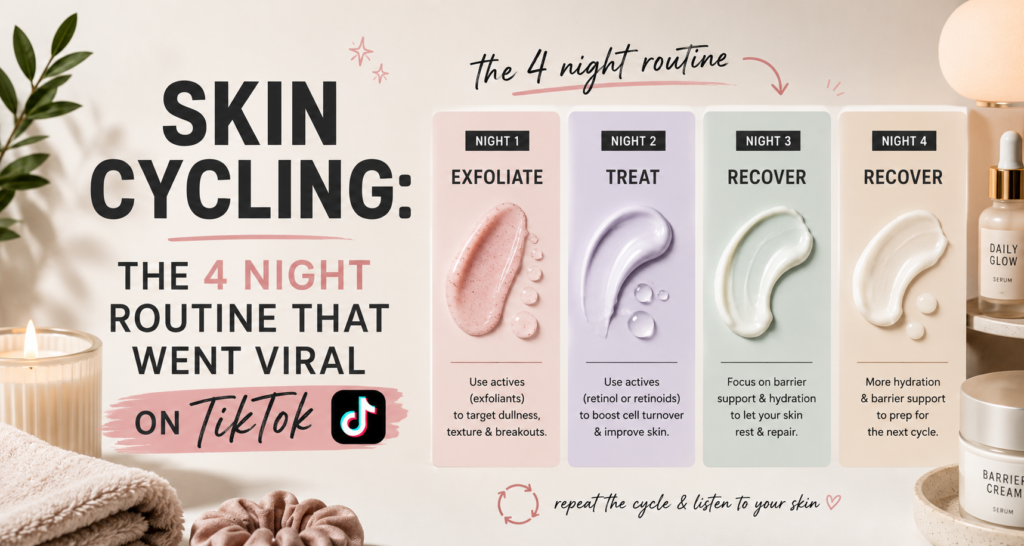
Someone holds up four fingers. Each finger represents a night. Night one — exfoliation. Night two — retinol. Night three — recovery. Night four — recovery. Repeat.
That is skin cycling. And despite how simple it sounds it genuinely changed how millions of people approach their skincare routine — including a lot of people who had been doing skincare wrong for years without realizing it.
The concept was popularized by New York dermatologist Dr. Whitney Bowe in 2022 and it spread across TikTok with a speed that most skincare trends never achieve. Not because it was trendy. Because it actually worked. People who had been struggling with irritation from retinol suddenly found they could tolerate it. People who had been over-exfoliating and wrecking their skin barrier finally gave their skin the recovery time it needed. People who thought they needed seventeen different products discovered that a four night rotation of four products produced better results than everything they had been doing before.
This guide explains exactly what skin cycling is, why the science behind it makes sense, how to build your own skin cycling routine from scratch, and which products to use at each stage depending on your skin type.
What Is Skin Cycling?
Skin cycling is a structured four night rotation that alternates between active ingredient nights and recovery nights. The core idea is that your skin needs time to repair itself between applications of strong actives — and that giving it that time does not reduce results. It actually improves them.
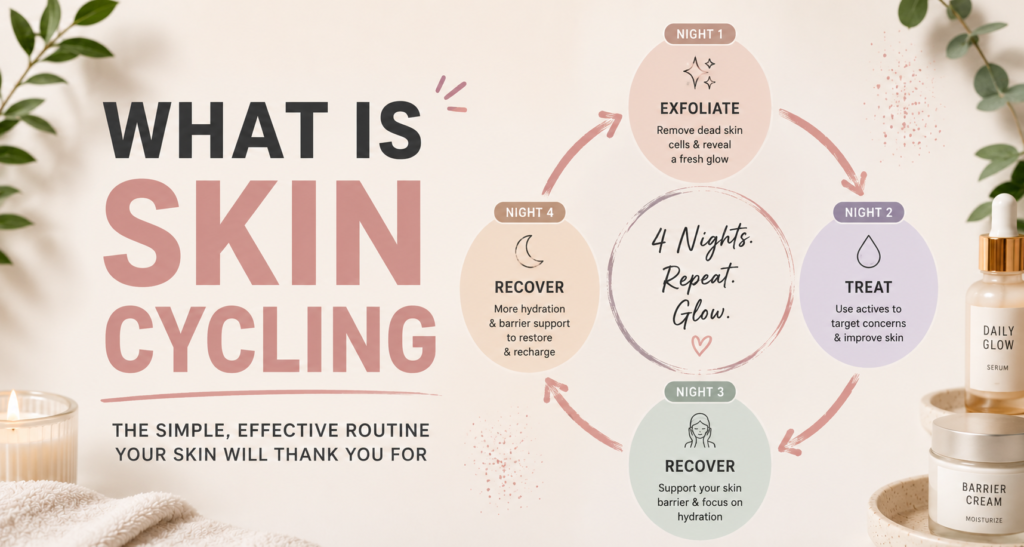
The standard skin cycling schedule looks like this:
Night one is exfoliation night. You apply a chemical exfoliant — an AHA or BHA acid — to resurface the skin, improve texture, and prepare the surface for the retinol that follows.
Night two is retinol night. With a freshly exfoliated skin surface, retinol penetrates more effectively and works more efficiently than it would on unexfoliated skin. The combination of exfoliation followed by retinol is what makes skin cycling produce faster results than either ingredient used independently.
Nights three and four are recovery nights. No actives. No acids. No retinol. Just hydration and barrier repair — the environment your skin needs to recover from the work done on nights one and two and rebuild itself stronger than before.
Then the cycle repeats.
It sounds almost too simple. But the simplicity is the point. Dr. Bowe’s insight was that most people using retinol and exfoliants were either using them too infrequently to see results or too frequently and damaging their skin barrier in the process. Skin cycling solved both problems simultaneously by creating a consistent, structured schedule that applies actives at the right frequency and gives the skin exactly the recovery time it needs between applications.
The Science Behind Why Skin Cycling Works
Understanding why skin cycling works makes it much easier to follow consistently — because you are not just following a routine, you are following a logical biological process.
Your skin barrier — the outermost protective layer of your skin — is made up of skin cells held together by lipids including ceramides, cholesterol, and fatty acids. This barrier keeps moisture in and environmental irritants out. When it is functioning correctly, skin looks plump, clear, and resilient. When it is damaged — through over-exfoliation, harsh actives, or simply not giving it recovery time — it becomes permeable, dehydrated, and reactive.
Retinol and chemical exfoliants are both effective precisely because they accelerate cellular processes. Retinol speeds up cell turnover. AHA and BHA acids dissolve dead cell buildup. But both of these processes also require energy and resources from the skin to execute. When you use actives every single night — as many skincare enthusiasts do — you are continuously demanding cellular work from a skin barrier that never gets a chance to complete its repair cycle.
The recovery nights in skin cycling are not passive. They are active recovery — nights where the skin uses the ceramide-rich moisturizers and hydrating ingredients you apply to rebuild the lipid barrier, complete the cellular renewal that the actives initiated, and restore the moisture levels that exfoliation and retinol can deplete.
Research published on PubMed demonstrates that skin barrier recovery requires at minimum 24 to 48 hours after exposure to exfoliating acids — which is precisely why the skin cycling schedule places a recovery night between exfoliation night and retinol night rather than stacking them on consecutive nights without a break.
The result of this structured approach is a skin barrier that gets stronger over time rather than progressively more depleted — which is what happens to most people who use actives daily without recovery periods built in.
Who Should Try Skin Cycling?
The honest answer is almost everyone — but certain groups benefit most dramatically.
People who are new to retinol are the most natural candidates for skin cycling. The two recovery nights significantly reduce the dryness, flaking, and redness that cause most people to abandon retinol before it has time to produce results. Starting retinol within a skin cycling framework rather than trying to use it daily from the beginning dramatically improves tolerance and the likelihood of sticking with it long enough to see the results.
People who have been over-exfoliating benefit enormously from the built-in recovery structure. If your skin has been feeling tight, reactive, slightly red, or perpetually sensitized despite your best skincare efforts — chronic over-exfoliation may be the cause. Skin cycling forces the recovery time your skin has been begging for.
People with sensitive skin who have always been afraid of retinol and acids can often use them successfully within a skin cycling framework when they could not tolerate them in a standard daily routine. The recovery nights provide enough barrier repair to compensate for the sensitivity that actives cause.
People with busy schedules love skin cycling because the built-in recovery nights mean simpler, faster routines two nights out of every four. Recovery nights are three steps maximum — cleanse, moisturizer, done. That simplicity on recovery nights makes the more involved active nights feel manageable rather than exhausting.
According to the American Academy of Dermatology, one of the most common reasons people fail to benefit from retinol is that they use it too aggressively before their skin has adapted — leading to irritation and abandonment. Skin cycling addresses this directly by structuring retinol use within a recovery framework from day one.
Night One — Exfoliation Night
Exfoliation night sets up the entire cycle. A well-exfoliated skin surface has fewer dead cells blocking the pathways through which retinol penetrates — meaning the retinol applied the following night works more effectively than it would on unexfoliated skin.
Choose either an AHA or a BHA depending on your primary skin concern.
AHA — alpha hydroxy acids including glycolic acid and lactic acid — work on the skin surface. They are best for dull skin, uneven texture, dry skin, and surface hyperpigmentation. Glycolic acid has the smallest molecular size of all AHAs and penetrates most deeply. Lactic acid is gentler — better for dry and sensitive skin.
BHA — beta hydroxy acid, specifically salicylic acid — is oil-soluble and penetrates into pores. It is the superior choice for oily skin, acne prone skin, blackheads, and enlarged pores. Its ability to dissolve the sebum-dead cell mixture inside pores from the inside makes it fundamentally different in function to AHAs regardless of concentration.
Apply your exfoliant after cleansing on a clean, dry face. Sweep it across the skin on a cotton pad or press it in gently with hands depending on the formula. Leave it on — do not rinse. Allow it to absorb for two to three minutes. Then apply your hydrating toner and moisturizer to seal the exfoliated surface.
The Paula’s Choice Skin Perfecting 2% BHA Liquid Exfoliant is the most consistently recommended BHA for skin cycling globally — effective enough to produce visible results, gentle enough to use as part of a structured rotation. Available at paulaschoice.com.
For AHA exfoliation the Paula’s Choice Skin Perfecting 8% AHA Gel Exfoliant delivers glycolic acid at a concentration that produces meaningful radiance improvement without the sensitivity associated with higher percentages. Available at paulaschoice.com.
For sensitive skin the Naturium Lactic Acid Serum 10% is a well-formulated lactic acid option that exfoliates gently while simultaneously hydrating — making it the kindest exfoliation option for skin that has previously reacted to glycolic acid. Available at Sephora.
What not to do on exfoliation night: Do not use your retinol. Do not use vitamin C. Do not layer multiple acids. One exfoliant applied correctly is all that is needed and all that the skin cycling schedule requires on night one.
Night Two — Retinol Night
This is the most important night in the cycle — and the one that produces the most significant long-term skin transformation when used consistently.
Retinol is a form of vitamin A that works by accelerating cell turnover and directly stimulating collagen production. The results over twelve to twenty-four weeks of consistent use are genuinely impressive — improved texture, reduced fine lines, more even skin tone, minimized pores, and a clarity to the complexion that no other single ingredient produces over the counter.
The freshly exfoliated skin from the previous night means retinol on night two penetrates more effectively than it would without that preparation. This is the elegant logic at the center of skin cycling — the sequence is not arbitrary. Each night sets up the next one.
Apply retinol after cleansing on slightly dry skin — waiting two to three minutes after patting dry before applying retinol reduces its irritation potential without reducing its efficacy. Apply a pea-sized amount — genuinely pea-sized, not a large squeeze — to the entire face. Press it gently in rather than rubbing.
For beginners the concentration you start with matters enormously. Starting too high causes the irritation — dryness, flaking, redness — that makes people abandon retinol before it has time to produce results.
The Ordinary Retinol 0.2% in Squalane is the standard beginner recommendation within the skin cycling community — low enough to minimize irritation, effective enough to produce results within the twelve week timeframe. Available at Sephora.
After four to six weeks with no significant irritation at 0.2% you can step up to The Ordinary Retinol 0.5% in Squalane — available at Sephora.
For skin that has used retinol before and wants stronger results the La Roche-Posay Effaclar Adapalene Gel 0.1% is a prescription-strength retinoid — adapalene — now available over the counter. Significantly more effective than standard retinol for acne, pore minimization, and skin renewal. Available at Dermstore.
The buffer method for retinol sensitivity: If you experience significant irritation on retinol night apply your moisturizer first and then apply retinol on top of it. This reduces penetration and therefore irritation while allowing your skin to adapt. As tolerance improves over weeks apply retinol directly to clean skin and use moisturizer after.
What not to do on retinol night: Do not use your acid exfoliant — using both on the same night amplifies irritation dramatically without improving results. Do not use vitamin C with retinol at night — vitamin C is a morning ingredient and combining it with retinol at night adds unnecessary active load. Do not use benzoyl peroxide on the same night — it degrades retinol and renders it ineffective.
Nights Three and Four — Recovery Nights
This is where most people make their mistake — treating the recovery nights as throwaway nights where nothing important happens. They are not. They are the nights where the transformation initiated by your actives is actually completed.
On nights three and four your skin is in the process of:
Completing the accelerated cell turnover that retinol started — new skin cells moving toward the surface need support to do so healthily. Rebuilding the ceramide layer that exfoliation temporarily disrupted. Restoring the moisture levels that both actives depleted. Reducing the low-level inflammation that even well-tolerated actives generate.
Recovery nights are not passive. They are repair nights. And the ingredients you apply on recovery nights directly determine how effectively your skin completes this repair process.
The recovery night routine is intentionally simple — three steps maximum.
Step 1 — Gentle cleanser
On recovery nights your cleanser should be the gentlest possible option. Your skin barrier is in a sensitized state from the actives of the previous two nights. An aggressive cleanser on a recovery night undoes the barrier repair you are trying to achieve. Rinse with lukewarm water and use a minimal amount of a hydrating cream cleanser.
The CeraVe Hydrating Facial Cleanser is the standard recovery night cleanser recommendation — it contains ceramides and hyaluronic acid and cleans without removing any barrier lipids. Available at Dermstore.
Step 2 — Hydrating serum or essence
After cleansing on recovery nights apply a hydrating serum focused on moisture replenishment and barrier support. No actives. No acids. No niacinamide if your skin is sensitive — save it for when barrier health is fully restored.
Hyaluronic acid applied to slightly damp skin provides the surface hydration that recovery nights need. The CosRx Snail Mucin 96% Power Repairing Essence is one of the most beloved recovery night serums within the skin cycling community — snail secretion filtrate contains growth factors and glycoproteins that actively accelerate skin healing and barrier repair. Available at Sephora.
Step 3 — Rich barrier repair moisturizer
The final step on recovery nights is the most important one — a ceramide-rich moisturizer that replenishes the lipid layer that exfoliation and retinol have temporarily depleted.
The CeraVe Moisturizing Cream is the most recommended recovery night moisturizer within the skin cycling community and for good reason. Three essential ceramides, hyaluronic acid, and cholesterol in a formula specifically designed to restore the skin barrier rather than just temporarily hydrate it. Apply generously as the final step on both recovery nights. Available at Dermstore.
For an extra layer of overnight barrier sealing on the second recovery night specifically — the night furthest from your next round of actives — a facial oil applied as the absolute final step over your moisturizer provides an occlusive seal that maximizes the barrier repair happening underneath. The Biossance Squalane Oil is a lightweight, non-comedogenic option that works for every skin type including oily and acne prone. Available at Sephora.
On the second recovery night some people incorporate a sleeping mask as the final step for intensive overnight hydration. The Laneige Water Sleeping Mask is the community favorite — available at Sephora.
How to Adapt Skin Cycling for Your Skin Type
The four night framework stays the same regardless of skin type — but the products and occasionally the timing within the cycle should be adapted for your individual skin.

Oily and acne prone skin
Use BHA as your night one exfoliant rather than AHA — salicylic acid’s ability to penetrate pores and dissolve sebum buildup makes it significantly more effective for oily and acne prone skin than surface-acting glycolic acid. Start retinol at the lowest available concentration and use the buffer method for the first four to six weeks. On recovery nights use lightweight gel moisturizer rather than a rich cream — the CeraVe PM Facial Moisturizing Lotion is better suited to oily skin than the heavier CeraVe Moisturizing Cream. Available at Dermstore.
Dry skin
Use lactic acid as your night one exfoliant — it exfoliates while simultaneously hydrating, which dry skin needs even on exfoliation nights. Start retinol at the lowest concentration available and use the buffer method consistently for the first eight weeks rather than four. On recovery nights use the richest ceramide moisturizer you can tolerate and add a facial oil as the final seal on both recovery nights rather than just the second one.
Combination skin
BHA works well across combination skin because it targets the oily T-zone where most concerns originate while being well-tolerated on the drier cheek areas. Standard retinol application applies to the whole face. Recovery nights use a gel-cream moisturizer that hydrates without congesting the oilier areas.
Sensitive skin
Start with a modified skin cycling schedule — two recovery nights for every one active night rather than the standard two-and-two. So exfoliation on night one, three recovery nights, retinol on night five, three more recovery nights, and then restart. This gentler introduction gives sensitive skin significantly more recovery time and produces better long-term tolerance. Lactic acid is the exfoliant of choice and the lowest available retinol concentration is non-negotiable. Build the schedule toward the standard four night cycle gradually over three to four months.
Skin Cycling vs Standard Skincare Routine — Which Produces Better Results?
This is the question the TikTok community debated extensively after skin cycling went viral — and the honest answer is nuanced.
For people who were already using retinol and exfoliants correctly in a well-structured standard routine skin cycling does not necessarily produce dramatically better results. A thoughtful standard routine that spaces actives appropriately and includes recovery time already captures most of the benefits skin cycling formalizes.
For people who were using actives incorrectly — daily retinol, daily exfoliation, no structured recovery — skin cycling produces dramatically better results because it introduces the recovery structure that was missing entirely.
For beginners skin cycling is superior to a standard routine as a starting framework because it is simple, the logic is clear, the schedule is easy to follow, and it builds tolerance for actives that would otherwise cause irritation and abandonment.
For people who struggled with retinol tolerance skin cycling is often the approach that finally makes retinol workable when nothing else did.
Common Skin Cycling Mistakes to Avoid
Skipping recovery nights when your skin feels good. This is the most common mistake. The recovery nights are not there because your skin is struggling — they are there to prevent it from struggling. Skipping them because your skin feels fine defeats the structural logic of the whole approach.
Using too strong a retinol at the start. Skin cycling does not eliminate retinol irritation entirely — it reduces it. Starting at too high a concentration on night two still causes significant irritation regardless of the recovery nights. Start at 0.2% and build slowly.
Adding extra actives on recovery nights. Niacinamide, vitamin C, peptides — some people cannot resist adding treatment products on recovery nights. For the first four to six weeks keep recovery nights strictly to cleanser, hydrating serum, and moisturizer. The simplicity is the point. You can reintroduce gentle non-active treatments on recovery nights after your barrier is established.
Expecting results in two weeks. Skin cycling produces visible texture improvement within four to six weeks for most people. Meaningful pore minimization, hyperpigmentation fading, and anti-ageing benefits from retinol take twelve weeks minimum. The TikTok before-and-afters that show dramatic results are from people who have been cycling consistently for three to six months — not two weeks.
Using physical scrubs on exfoliation night instead of chemical exfoliants. Physical scrubs create microscopic tears in the skin barrier and cause inflammation that the recovery nights then have to repair on top of the retinol recovery they were designed for. Always use chemical exfoliants — AHA or BHA — not scrubs.
Your Complete Skin Cycling Shopping List
You need exactly four products to start skin cycling. Nothing more.
Exfoliant for night one: Paula’s Choice 2% BHA for oily skin or Paula’s Choice 8% AHA for normal to dry skin. Available at paulaschoice.com.
Retinol for night two: The Ordinary Retinol 0.2% in Squalane for beginners. Available at Sephora.
Hydrating serum for recovery nights: CosRx Snail Mucin 96% Power Repairing Essence. Available at Sephora.
Barrier repair moisturizer for recovery nights: CeraVe Moisturizing Cream. Available at Dermstore.
Total cost: approximately $60 to $70 for a complete skin cycling setup. Every product lasts two to three months used within the skin cycling schedule because you are only using the actives two nights out of every four.
How Skin Cycling Fits Into Your Complete Skincare Routine
Skin cycling is your evening routine framework — it does not change your morning routine at all. Your morning routine stays consistent every day: gentle cleanser, vitamin C serum, moisturizer, SPF. The skin cycling rotation only applies to what you do at night.
The morning after exfoliation night your skin may feel slightly more sensitive — use your gentlest morning cleanser and make sure SPF is applied thoroughly since freshly exfoliated skin is more susceptible to UV damage. The morning after retinol night apply your vitamin C serum as normal — the combination of previous night retinol and morning vitamin C provides excellent all-around skin renewal and protection.
The morning after recovery nights your skin should feel its best — most hydrated, most comfortable, most luminous. This is when the overnight barrier repair work shows on the surface.
If you want to know exactly which products from this guide are right for your specific skin type and concerns the free AI skin analysis at yourskingpt.com/skin-analysis analyzes your actual skin from a selfie and builds a complete personalized routine in fifteen seconds — completely free with no account required.
You might also find our guides on night skincare routine and morning skincare routine order helpful for building the complete picture around your skin cycling framework.
Frequently Asked Questions
Can I do skin cycling if I have never used retinol before? Yes — skin cycling is actually the ideal way to start retinol for the first time. The two recovery nights significantly reduce the irritation that causes most retinol beginners to quit before seeing results. Start at the lowest available concentration — 0.2% — and follow the cycle exactly as described. You can expect your skin to adjust within four to six weeks.
What if I want to cycle faster than every four nights? Dr. Bowe’s original recommendation is four nights — two active and two recovery. Shortening the recovery period to one night and cycling every three nights is something some experienced skincare users do after establishing strong retinol tolerance. For beginners two full recovery nights is non-negotiable. Some people with sensitive skin benefit from extending to two active nights and three recovery nights for a five night cycle.
Do I need to do skin cycling forever? No. Skin cycling is a framework for building tolerance and establishing a sustainable active ingredient routine — not a permanent constraint. After three to six months of skin cycling most people have established sufficient retinol tolerance and barrier strength to move to a more flexible routine if they choose. Many people simply continue cycling because the structured approach continues to produce good results indefinitely.
Can I use skin cycling during pregnancy? Retinol is contraindicated during pregnancy — all forms of vitamin A derivatives should be avoided. Skin cycling without the retinol night — using exfoliation and recovery nights only — is perfectly safe. Replace retinol night with an additional recovery night or a gentle peptide serum night for the duration of pregnancy.
Is skin cycling suitable for acne prone skin? Yes — and it is particularly effective for acne prone skin because BHA exfoliation on night one directly targets the pore congestion that causes breakouts, while retinol on night two accelerates cell turnover that prevents future congestion and fades post-acne marks simultaneously. The recovery nights provide the barrier support that prevents the skin from becoming so irritated by actives that it produces compensatory excess oil.
What does skin cycling do for dark spots? The combination of exfoliation and retinol within the skin cycling schedule addresses hyperpigmentation through two complementary mechanisms. Exfoliation removes the surface cells that contain oxidized melanin — gradually lightening existing dark spots. Retinol accelerates cell turnover which speeds the replacement of pigmented cells with new unpigmented ones. Consistent skin cycling over twelve weeks produces meaningful improvement in most post-acne marks and moderate sun spots.
The Bottom Line
Skin cycling is not a trend that happened to go viral. It is a logical, evidence-supported framework for using the most effective skincare actives — exfoliants and retinol — in a way that maximizes their benefits while giving your skin barrier the recovery time it genuinely needs.
The four night structure is simple enough to follow consistently, flexible enough to adapt to every skin type, and effective enough to produce the kind of results that make other people ask what changed about your skin.
Start with four products. Follow the four night schedule. Give it twelve weeks. The skin that comes out the other side of three months of consistent skin cycling is genuinely different to the skin that went in.
The free AI skin analysis at yourskingpt.com/skin-analysis builds a personalized skin cycling routine for your specific skin type — telling you exactly which exfoliant, which retinol concentration, and which recovery products are right for your individual skin rather than a generic recommendation. Free, in fifteen seconds, no account required.
This article is for informational purposes only and does not constitute medical advice. Always consult a qualified dermatologist before starting retinol or prescription-strength actives, particularly if you have a diagnosed skin condition.