
Finding a good sunscreen for acne prone skin feels like searching for something that should not exist.
Every dermatologist on earth tells you to wear SPF every single day. You know they are right. You know what happens to skin that does not get protected — the hyperpigmentation, the collagen breakdown, the premature ageing that no serum can reverse. You want to wear sunscreen. You genuinely do.
And then you put it on and break out.
Or it makes your already oily skin look like a glazed donut by 10am. Or it pills under your moisturizer. Or it leaves a white cast that makes you look like you applied chalk to your face. So you stop wearing it. Or you wear it sporadically. Or you tell yourself your moisturizer with SPF 15 is probably enough.
It is not. But the frustration is completely valid — because most sunscreens genuinely are not formulated with acne prone skin in mind. The thick emollients and heavy bases that make sunscreen comfortable for dry skin are exactly the kinds of ingredients that clog pores and trigger breakouts on oily and acne prone skin.
The good news is that the sunscreen market has changed dramatically in the last five years. There are now genuinely excellent sunscreen formulas specifically developed for oily, acne prone, and sensitive skin — formulas that absorb completely, leave a matte finish, do not cause breakouts, and provide real broad-spectrum protection. Finding them is the hard part. This guide does that work for you.
Why Most Sunscreens Break Out Acne Prone Skin
Before getting to the product list it helps to understand why sunscreens cause breakouts — because knowing the mechanism helps you identify which ingredients to avoid on every product you buy going forward, not just sunscreen.
The primary culprits are emollients and film-forming agents. Sunscreen formulas need to spread evenly across the skin surface and stay there despite sweat and sebum. To achieve this they use emollients — ingredients that create a smooth, spreadable texture — and film-forming polymers that help the formula adhere to the skin. Many of these ingredients are highly comedogenic on acne prone skin.
The most problematic ingredients in sunscreen for acne prone skin include coconut oil and coconut-derived ingredients which have one of the highest comedogenic ratings of any ingredient in skincare. Isopropyl myristate and isopropyl palmitate — common sunscreen emollients — are consistently flagged as pore-clogging by dermatologists. Lanolin creates a heavy occlusive layer that traps sebum and dead cells in pores. Silicones — while generally considered non-comedogenic — can trap oil underneath on very oily skin and contribute to congestion with prolonged daily use.
Additionally many sunscreen formulas use alcohol as a texture modifier. While alcohol is not comedogenic it is drying — and on oily skin that compensates for dryness by producing more oil, alcohol-containing sunscreens can trigger increased sebum production that makes oiliness and breakouts worse over time.
Chemical sunscreen filters themselves — avobenzone, octinoxate, oxybenzone — are not typically comedogenic. But the bases that carry them frequently are. This is why some people find they tolerate mineral sunscreens better than chemical ones — mineral formulas often use simpler, lighter bases because the zinc oxide or titanium dioxide particles do not need to be dissolved in the same way chemical filters do.
Understanding these mechanisms means you know what to look for on every label — not just the ones in this guide.
Mineral vs Chemical Sunscreen for Acne Prone Skin
This is the debate that fills skincare forums and the answer is genuinely more nuanced than most content acknowledges.
Mineral sunscreens use zinc oxide or titanium dioxide as their active ingredients. These mineral particles sit on the skin surface and physically reflect UV radiation rather than absorbing it. For acne prone skin mineral sunscreens have several advantages: zinc oxide is a genuinely anti-inflammatory ingredient that reduces redness and soothes irritated skin. Mineral formulas tend to have simpler ingredient lists with fewer potential comedogenic emollients. And zinc oxide has mild antimicrobial properties that are modestly beneficial for acne prone skin.
The traditional downside of mineral sunscreens was the white cast — the chalky residue left by zinc oxide and titanium dioxide particles on skin. This has improved dramatically in recent years with the development of micronized and nano-sized mineral particles that are far less visible on skin while still providing protection. The best modern mineral sunscreens for medium to deep skin tones are genuinely wearable in a way that earlier mineral formulas were not.
Chemical sunscreens absorb UV radiation and convert it to heat rather than reflecting it. They tend to be thinner, more transparent, and more cosmetically elegant — particularly important for darker skin tones where even modern mineral formulas can leave a noticeable cast. The best modern chemical and hybrid sunscreens for acne prone skin use lightweight, non-comedogenic bases that have nothing in common with the thick, heavy chemical sunscreens of fifteen years ago.
For most people with acne prone skin the honest answer is that the best sunscreen is the one you will actually wear every single day. A slightly less theoretically ideal formula worn consistently beats a theoretically perfect formula that sits unused because you do not like how it feels. With that said the products below are the best available options across both mineral and chemical categories for acne prone skin specifically.
What to Look for in a Sunscreen for Acne Prone Skin
Before the product list — the label checklist that applies to every sunscreen you consider buying for acne prone skin.
Non-comedogenic is the first thing to look for. This means the formula has been tested for pore-clogging potential. Not every brand tests rigorously but the established dermatologist-recommended brands generally do and stand behind the claim.
Oil-free means the formula contains no oils that can contribute to pore congestion. For very oily skin this is particularly important. Oil-free does not mean the product cannot be hydrating — water-based hydrating ingredients like glycerin and hyaluronic acid provide moisture without any comedogenic risk.
Broad-spectrum means the sunscreen protects against both UVA and UVB radiation. UVB causes sunburn. UVA causes premature ageing, hyperpigmentation, and deeper cellular damage. You need protection from both. Do not buy any sunscreen that does not say broad-spectrum on the label.
SPF 30 minimum — SPF 30 blocks approximately 97% of UVB radiation. SPF 50 blocks approximately 98%. The difference sounds small but is meaningful for daily cumulative protection. SPF 50 is preferable for daily face use particularly if you spend time outdoors.
Fragrance-free is strongly preferable for acne prone skin. Fragrance is the most common cause of contact dermatitis and skin irritation in skincare products and irritated skin breaks out more. Many sunscreens marketed for sensitive or acne prone skin still contain fragrance — read the label rather than trusting the marketing.
Matte or lightweight finish matters practically. A sunscreen that creates a shiny, greasy finish on oily skin is a sunscreen that will not be worn consistently. Mattifying agents like silica, niacinamide, and certain polymers in sunscreen formulas create a non-greasy finish that makes daily wear realistic on oily and combination skin.
The Best Sunscreens for Acne Prone Skin in 2026
These eight products are selected based on formulation quality, dermatologist recommendation frequency, real-world performance on acne prone skin, and availability.
1. La Roche-Posay Anthelios Clear Skin SPF 60
This is the sunscreen that appears most consistently on dermatologists’ recommendation lists for oily and acne prone skin — and for very good reason. La Roche-Posay developed the Anthelios Clear Skin formula specifically for oily, breakout-prone skin and the result is one of the most effective matte-finish sunscreens available anywhere at any price point.
It uses a patented Mexoryl SX and XL filter system alongside oil-absorbing Micropearl technology that controls shine for up to eight hours. The finish is genuinely matte — not pretend-matte like many formulas that claim it. It absorbs completely within sixty seconds of application, does not pill under makeup, does not leave any white cast, and has never been associated with causing breakouts in clinical testing.
The formula is fragrance-free, non-comedogenic, and specifically tested on acne prone skin. At SPF 60 it provides more than adequate protection for daily use including days with significant outdoor time.
The one caveat worth mentioning — the formula contains alcohol fairly high in the ingredients list which some people with very dry acne prone skin find drying over time. For oily skin this is genuinely not a concern and often welcomed for its contribution to the matte finish.
Best for: oily and combination acne prone skin, people who wear makeup, anyone who has tried and failed with other sunscreens due to shine or breakouts. Available at Dermstore.
2. EltaMD UV Clear Broad-Spectrum SPF 46
EltaMD UV Clear is the other sunscreen that comes up constantly in dermatology office recommendations — and it has a devoted following among people with acne prone, rosacea-prone, and post-procedure skin for good reason.
The formula contains 9% zinc oxide alongside niacinamide — which means you are getting genuine anti-inflammatory and sebum-regulating benefits alongside your UV protection. For acne prone skin that combination is particularly valuable: the zinc oxide provides physical UV protection and anti-inflammatory benefits, the niacinamide works on the skin surface to reduce redness and regulate oil simultaneously.
The texture is a lightweight lotion that absorbs within thirty seconds and leaves a slightly translucent finish — not fully matte but not shiny. It works equally well as a standalone morning product for days when you are not wearing makeup, and as a base under foundation without pilling.
It is available in a tinted version for people who want a subtle color correction alongside their SPF — the tinted version provides light coverage that evens skin tone while protecting it.
Best for: acne prone skin with simultaneous sensitivity or rosacea, post-treatment skin, people who want niacinamide benefits built into their SPF. Available at Dermstore.
3. Beauty of Joseon Relief Sun Rice and Probiotics SPF 50+ PA++++
This Korean sunscreen has gone from a niche recommendation to one of the most talked about sunscreens globally over the last two years — and the enthusiasm is entirely justified.
The formula uses a hybrid of mineral and chemical filters alongside rice extract and probiotics that support the skin microbiome. The texture is unlike any Western sunscreen — it applies like a serum, absorbs in under thirty seconds, leaves absolutely no white cast, and creates a soft-focus skin-smoothing effect that actually improves the appearance of pores rather than sitting in them.
For medium and deeper skin tones this is one of the very few mineral-containing sunscreens that works without a visible cast — a significant gap in the sunscreen market that Korean formulation has addressed more effectively than most Western brands.
The PA++++ rating refers to the Japanese UVA protection rating system — four plus signs represents the highest available protection against UVA radiation. Combined with SPF 50 this is genuinely comprehensive protection that matches or exceeds most Western SPF 50 formulas.
Best for: combination and oily acne prone skin, medium to deep skin tones, people who have never found a sunscreen they actually enjoy wearing. Available at Sephora.
4. Neutrogena Clear Face Liquid Lotion Sunscreen SPF 55
The most accessible and widely available option on this list — available at pharmacies, supermarkets, and convenience stores everywhere. Neutrogena specifically formulated Clear Face for acne prone skin and the formula delivers on that promise consistently.
It uses a helioplex filter system that provides stable broad-spectrum protection, a lightweight lotion texture that absorbs without greasiness, and an oil-free formula that has been clinically tested not to cause breakouts. It is fragrance-free and compatible with most acne treatment products including benzoyl peroxide and salicylic acid without causing the pilling or separation that some sunscreens produce when layered over acne treatments.
At under $15 it is the most budget-friendly option on this list and one that performs significantly above its price point for oily and acne prone skin.
Best for: acne prone skin on a budget, everyday wear, people who go through sunscreen quickly and need an affordable option for generous daily application. Available at Dermstore.
5. Supergoop Unseen Sunscreen SPF 40
The Supergoop Unseen Sunscreen redefined what people expected from a sunscreen texture when it launched and it remains one of the most uniquely formulated options available for oily and acne prone skin.
The texture is a completely clear, weightless gel that disappears entirely on application — no white cast, no residue, no shine. It works as a makeup primer, extending the wear of foundation applied over it. The formula uses red algae and meadowfoam seed oil alongside its chemical UV filters in a base specifically designed for oily skin types.
It does contain some silicones which some people with very congestion-prone skin prefer to avoid — but for most oily and acne prone skin types the formula is genuinely non-comedogenic and the silicones contribute to the smooth, pore-minimizing finish rather than causing issues.
Best for: oily skin that wants a primer and SPF in one step, people who wear makeup daily and need their sunscreen to work under foundation, minimalists who want fewer morning routine steps. Available at Sephora.
6. ISDIN Eryfotona Actinica Ultralight Emulsion SPF 50+
A dermatologist favorite that is less widely known in the general consumer market but consistently recommended by skin cancer specialists and dermatologists treating photodamaged skin.
The formula contains 100% mineral protection through zinc oxide alongside DNA repairsomes — encapsulated enzymes that actively repair UV-induced DNA damage in skin cells. This is genuinely novel technology — most sunscreens prevent new damage. ISDIN Eryfotona actively reverses existing damage while preventing new damage simultaneously.
According to research referenced on Healthline, mineral-only formulations with zinc oxide are among the safest options for acne prone skin due to zinc’s anti-inflammatory properties and the absence of potentially comedogenic chemical filter bases.
The texture is a lightweight emulsion that absorbs quickly and leaves a natural finish — not fully matte but not shiny. Works well on normal to combination skin.
Best for: skin with existing photodamage, acne prone skin with simultaneous hyperpigmentation concerns, anyone whose dermatologist has recommended maximum sun protection. Available at Dermstore.
7. Paula’s Choice Resist Super-Light Daily Wrinkle Defense SPF 30
Paula’s Choice approaches sunscreen with the same evidence-based formulation philosophy it applies to every product — no unnecessary ingredients, no fragrance, no marketing fluff, just a well-constructed formula that does what it says.
The Resist Super-Light Daily Wrinkle Defense combines SPF 30 protection with antioxidants including green tea, vitamin C, and vitamin E in a lightweight formula that works particularly well for acne prone skin that is simultaneously concerned about ageing. The antioxidant complex amplifies the UV protection and provides additional defense against the free radical damage that causes premature ageing alongside the UV damage SPF prevents.
The texture is a light fluid that absorbs completely and leaves no residue. It is fragrance-free, non-comedogenic, and formulated without any of the known pore-clogging ingredients common in other sunscreens.
Best for: acne prone skin with anti-ageing concerns, people in their late twenties and thirties who want sun protection and antioxidant benefits in one step. Available at paulaschoice.com.
8. Purito Daily Go-To Sunscreen SPF 50+ PA++++
Another Korean formulation that has built a significant following among skincare enthusiasts with acne prone skin — and one of the most affordable high-performance sunscreens available in its category.
The formula uses a blend of chemical filters in a water-based base that is genuinely lightweight — closer to a hydrating toner in texture than a traditional sunscreen. It absorbs in seconds, leaves no white cast, no sticky residue, and no shine. The fragrance-free, alcohol-free formula is well-tolerated by even sensitive acne prone skin.
At PA++++ it provides the highest available UVA protection rating alongside SPF 50 — comprehensive protection that rivals formulas costing three times as much.
The only practical note is that the water-based formula may not be as sweat-resistant as some other options — for people who exercise outdoors or spend extended time in the sun a more water-resistant formula like the La Roche-Posay Anthelios is more appropriate.
Best for: acne prone skin on a moderate budget, people who want a lightweight everyday formula, daily indoor-to-outdoor use without extended sun exposure. Available at Dermstore.
How to Apply Sunscreen Correctly on Acne Prone Skin
Choosing the right sunscreen is half the battle. Applying it correctly determines whether it actually provides the protection it promises.
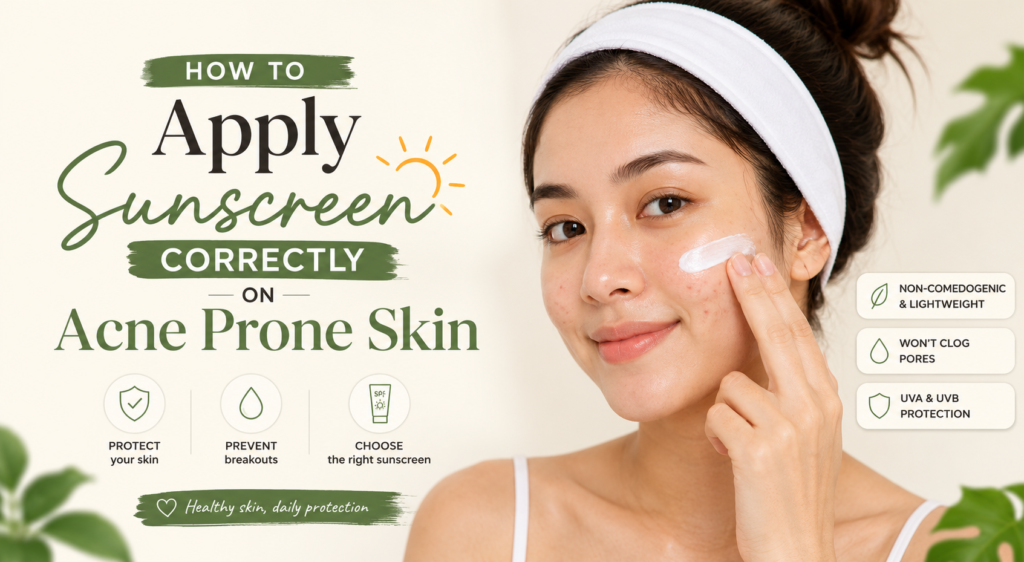
Use enough product. The standard recommendation is a quarter teaspoon for the face alone — approximately two finger lengths of product from the tip of your index and middle fingers. Most people apply roughly half this amount which means their effective SPF is significantly lower than the number on the bottle. A sunscreen applied at half the recommended amount provides approximately the square root of its labeled SPF — so SPF 50 applied too thinly delivers the protection of roughly SPF 7.
Apply it as the absolute last step in your morning routine — after your moisturizer has had sixty seconds to absorb. Applying sunscreen immediately over still-wet moisturizer creates an uneven layer that provides inconsistent protection.
Do not rub it in aggressively. Press and pat rather than rubbing. Rubbing disrupts the even film that provides protection and on acne prone skin aggressive rubbing creates friction that can irritate active breakouts.
Reapply every two hours if you are spending time outdoors. Indoor office workers who go outside for lunch and a brief commute can realistically get away with morning-only application. Anyone spending meaningful time outdoors — more than thirty minutes — needs to reapply.
Do not mix sunscreen with your moisturizer before applying. Mixing dilutes the formula and disrupts the protective film. Apply them as separate layers in sequence.
Building SPF Into a Complete Morning Routine for Acne Prone Skin
Sunscreen performs best as part of a complete morning routine rather than as a standalone product applied to an unprepared skin surface. For acne prone skin the optimal morning routine framework is:
Gentle foaming or gel cleanser to remove overnight sebum and product residue without stripping the barrier. The CeraVe Foaming Facial Cleanser is the standard recommendation. Available at Dermstore.
Niacinamide serum to regulate sebum production throughout the day, minimize pore appearance, and reduce the inflammation that causes and worsens breakouts. Applied before moisturizer and SPF it works as a treatment layer that sets up the skin for the day. The Ordinary Niacinamide 10% + Zinc 1% available at Sephora.
Lightweight oil-free moisturizer to hydrate the skin and create a smooth base for SPF application. On oily skin a gel moisturizer like the Neutrogena Hydro Boost Water Gel applied in a thin layer provides adequate hydration without any greasiness. Available at Dermstore.
SPF as the final step — your chosen formula from the list above applied generously and evenly as the absolute last layer before going outside.
This four-step morning routine addresses oiliness, treats active concerns, hydrates without congesting, and protects against the UV damage that makes existing acne scarring and hyperpigmentation worse. It takes eight to ten minutes and costs under $60 for all four products combined.
If you want to know exactly which sunscreen and which morning routine products are right for your specific skin type and concerns the free AI skin analysis at yourskingpt.com/skin-analysis analyzes your actual skin from a selfie and builds a complete personalized morning routine with specific product recommendations in fifteen seconds. Completely free with no account required.
You might also find our complete guides on morning skincare routine order and best moisturizer for acne prone skin useful for building the complete morning routine around your sunscreen.
Frequently Asked Questions
Can sunscreen cause acne? Yes — the wrong sunscreen can cause acne. Sunscreens containing comedogenic emollients like coconut oil, isopropyl myristate, or lanolin can clog pores and trigger breakouts on acne prone skin. The sunscreens on this list are specifically formulated to avoid these ingredients. If you have been breaking out from sunscreen, switching to one of the non-comedogenic formulas above and giving your skin two weeks to adjust typically resolves the issue.
Is SPF 30 enough for acne prone skin? SPF 30 is the minimum recommended by the American Academy of Dermatology for daily face use. For acne prone skin specifically SPF 50 is preferable because post-inflammatory hyperpigmentation — the dark marks left by breakouts — is significantly worsened by UV exposure. Protecting those marks from UV while they fade is one of the most effective ways to speed up the healing process.
Should I use mineral or chemical sunscreen for acne? Both can work well for acne prone skin when properly formulated. Mineral sunscreens with zinc oxide have anti-inflammatory benefits that are modestly helpful for acne. Chemical sunscreens tend to be more cosmetically elegant and less likely to leave a white cast on medium to deep skin tones. The most important factors are non-comedogenic formulation, oil-free base, and fragrance-free formula — regardless of whether the formula is mineral or chemical.
How do I remove sunscreen properly at night? Sunscreen requires double cleansing to remove properly — particularly water-resistant formulas. An oil cleanser or micellar water as the first cleanse dissolves the sunscreen completely. A gentle face wash as the second cleanse removes any remaining residue. Sleeping with sunscreen residue in your pores overnight is a significant contributor to breakouts on acne prone skin.
Can I use SPF moisturizer instead of separate sunscreen? A dedicated sunscreen provides better and more reliable protection than an SPF moisturizer for two reasons. First most people do not apply enough moisturizer to achieve the labeled SPF protection — you would need to apply four to five times the normal amount of moisturizer to get the SPF on the label. Second moisturizer formulas are not optimized for UV-filter stability the way dedicated sunscreen formulas are. Use them as separate products for reliable protection.
Does sunscreen prevent acne scars from getting darker? Yes — this is one of the most important and underappreciated reasons for acne prone skin to wear daily SPF. Post-inflammatory hyperpigmentation — the dark marks left after breakouts heal — is significantly worsened by UV exposure. Every day you go without SPF over existing dark marks exposes the hyperpigmented cells to UV radiation that deepens and prolongs them. Consistent daily SPF is one of the most effective interventions for fading acne scars alongside dedicated brightening ingredients.
The Bottom Line
There is a sunscreen for every skin type — including yours. The days of choosing between protecting your skin from UV damage and protecting it from breakouts are genuinely over. The formulas on this list prove that those two goals are not mutually exclusive.
Start with the La Roche-Posay Anthelios Clear Skin SPF 60 if you have oily or combination acne prone skin and want the most dermatologist-endorsed matte formula available. Try the Beauty of Joseon Relief Sun if you want the most cosmetically elegant lightweight option that works across skin tones. Go with the EltaMD UV Clear if you have simultaneous sensitivity or rosacea alongside your acne concerns.
Whichever formula you choose — wear it every single day. The hyperpigmentation left by breakouts heals in weeks when it is consistently protected from UV. Without protection it can take years. That alone makes daily sunscreen one of the highest-impact things you can do for acne prone skin regardless of every other product in your routine.
The free AI skin analysis at yourskingpt.com/skin-analysis tells you exactly which sunscreen and which complete morning routine is right for your specific skin — free in fifteen seconds based on your actual skin.
This article is for informational purposes only and does not constitute medical advice. Always consult a qualified dermatologist for persistent acne concerns or before making significant changes to your skincare routine.